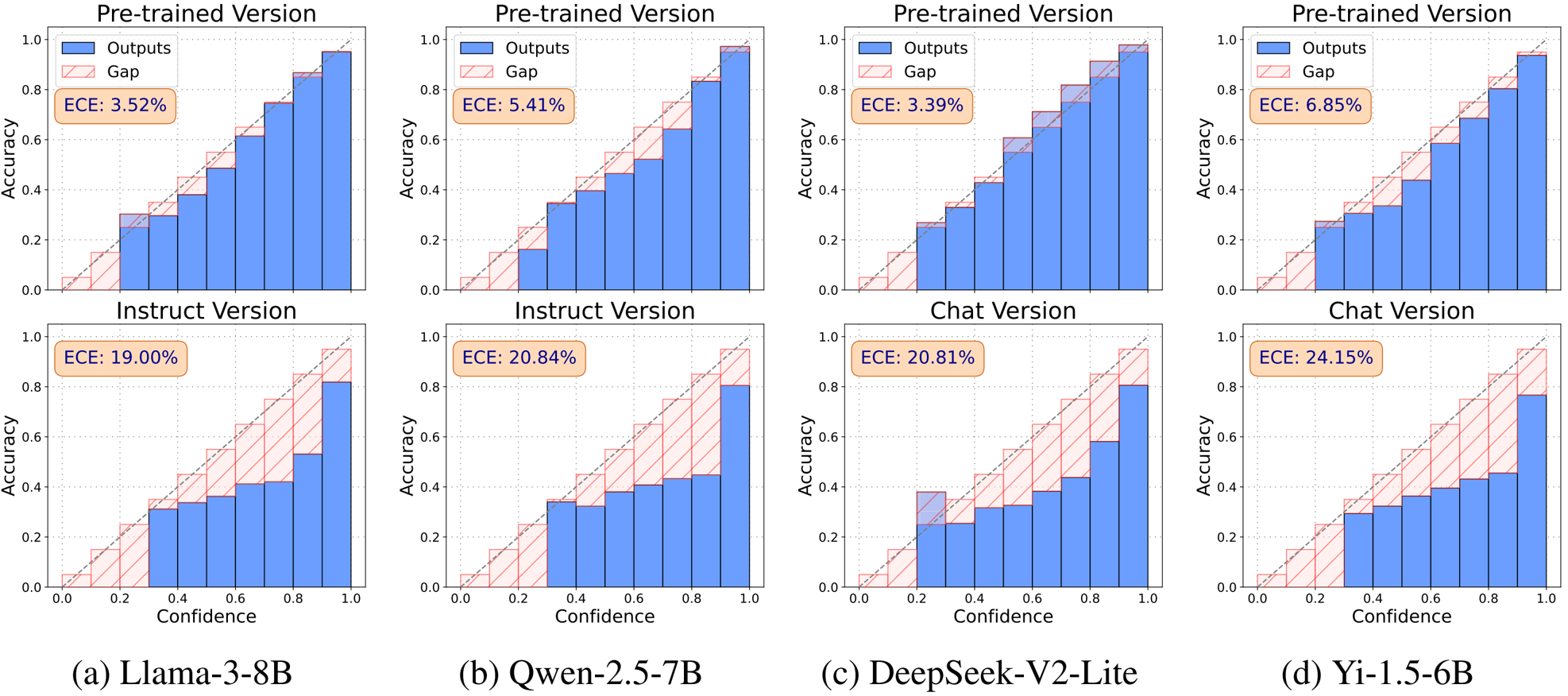
Post-trained language models (PoLMs) are essential for aligning large language models with human preferences, but they often suffer from over-confidence—assigning high confidence to both correct and incorrect outputs. This undermines reliability, especially in high-stakes domains like medicine and security. While pre-trained language models (PLMs) tend to be well-calibrated, post-training disrupts this property. Traditional calibration methods like temperature scaling require labeled data, which is scarce and expensive to obtain for many real-world tasks. This creates a critical gap: how to calibrate PoLMs effectively without access to labeled data?
We propose Disagreement-Aware Confidence Alignment (DACA), an unsupervised post-hoc calibration method that leverages the well-calibrated nature of pre-trained models (PLMs) to calibrate post-trained models (PoLMs) using only unlabeled data. Instead of aligning confidence across all examples, DACA selectively uses agreement examples—those where the PLM and PoLM produce the same prediction. This avoids the under-confidence issue caused by prediction disagreement. Formally, given logits from the PoLM $ g(x) $ and softmax outputs from the PLM $ p(x) $, DACA optimizes the temperature $ \tau $ by minimizing KL divergence only on agreement samples:
This ensures that confidence alignment occurs only when the PLM’s confidence is a reliable proxy for correctness.
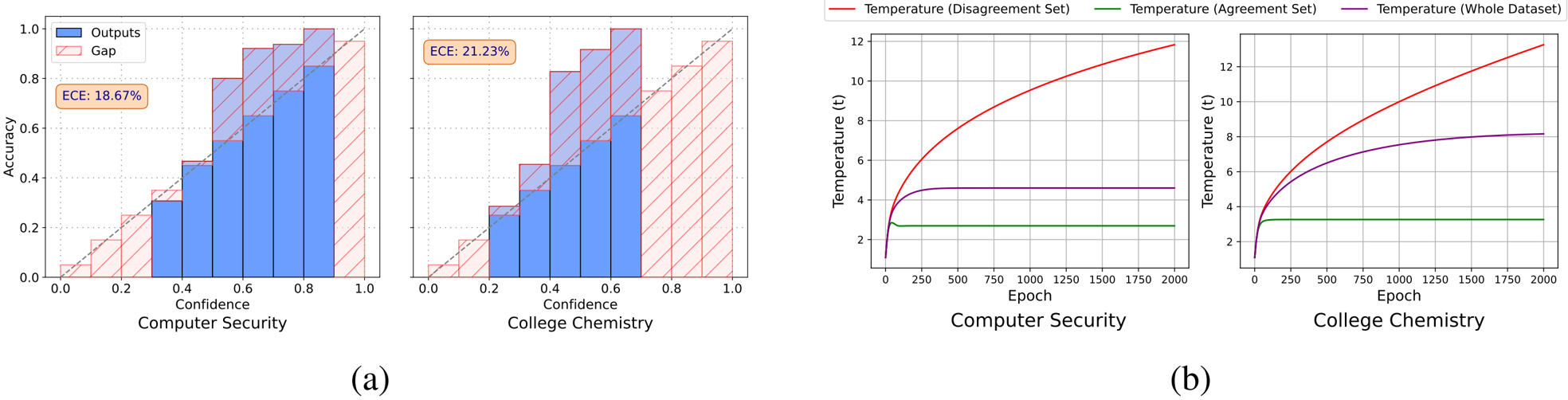
We show theoretically that naive confidence alignment—aligning PLM and PoLM confidence on all unlabeled data—can lead to under-confidence. When the two models disagree, the PLM’s confidence reflects its own accuracy, not the PoLM’s. Since post-training often improves accuracy, the PoLM may be correct even when the PLM is not, causing the PLM’s confidence to underestimate the PoLM’s true correctness likelihood. This leads to an inflated temperature $ \tau $ during optimization, resulting in under-confidence. Proposition 3.3 shows that on disagreement examples where $ \sigma_c(f(x)) < 1/k $, the gradient of the KL divergence w.r.t. $ \tau $ remains positive, pushing $ \tau $ to larger values. DACA eliminates this effect by excluding disagreement examples, enabling more accurate and stable temperature estimation.
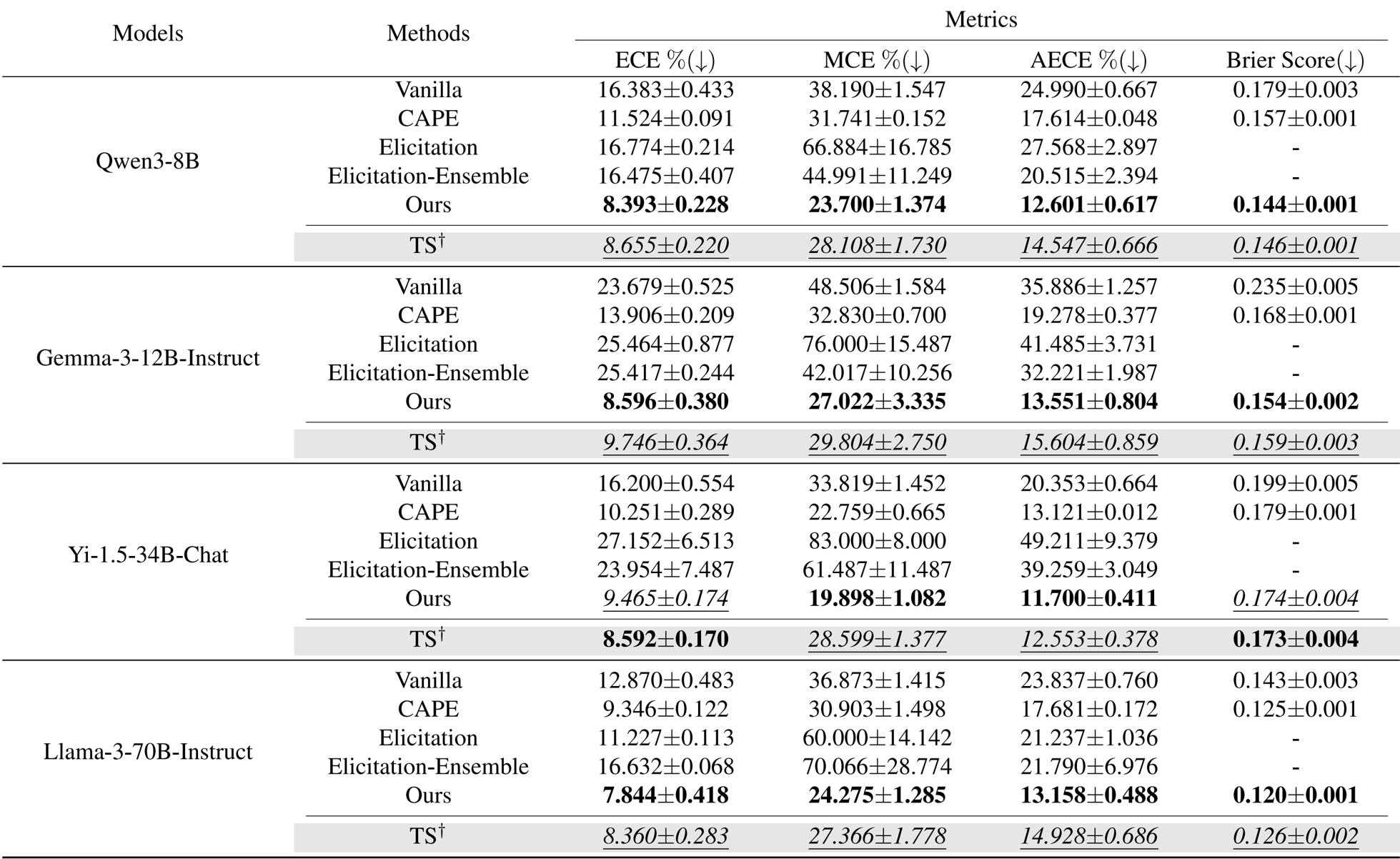
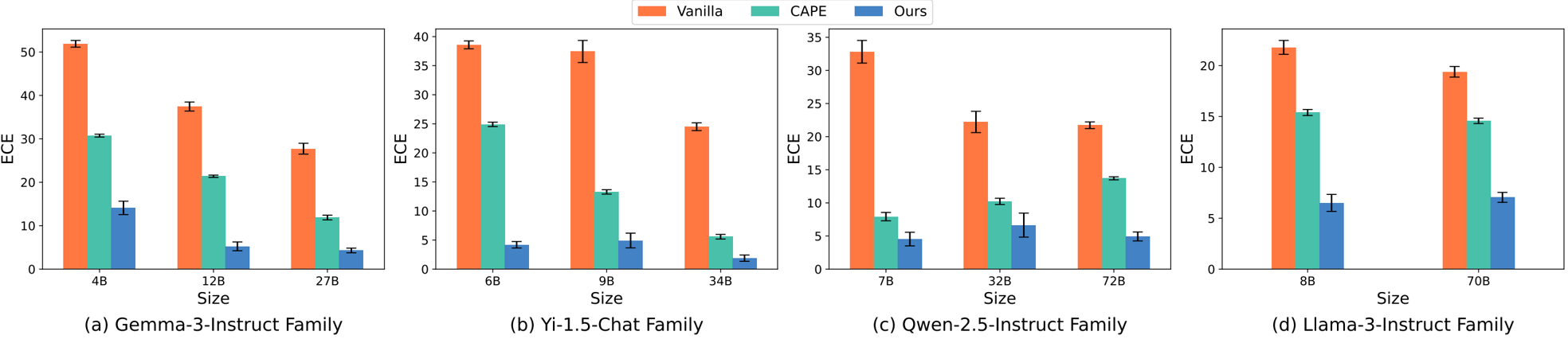
We evaluate DACA across diverse LLMs—including Llama-3, Gemma-3, Qwen2.5, Yi-1.5, GPT-4o, and DeepSeek-V3—on standard benchmarks like MMLU, MedMCQA, and MathQA. DACA consistently improves calibration, reducing ECE by up to 15.08% across models. On MMLU, it reduces the ECE of Gemma-3-12B-Instruct from 23.68% to 8.60%, outperforming supervised temperature scaling (9.75%). It also excels on MedMCQA, cutting GPT-4o’s ECE from 21.23% to 6.99% using a smaller pre-trained model. DACA outperforms baselines like CAPE and verbalization-based elicitation methods, and remains effective across model sizes and architectures. It is robust to different post-training techniques (SFT, RLHF, DPO), improving calibration across all variants of Llama-3.1-8B.
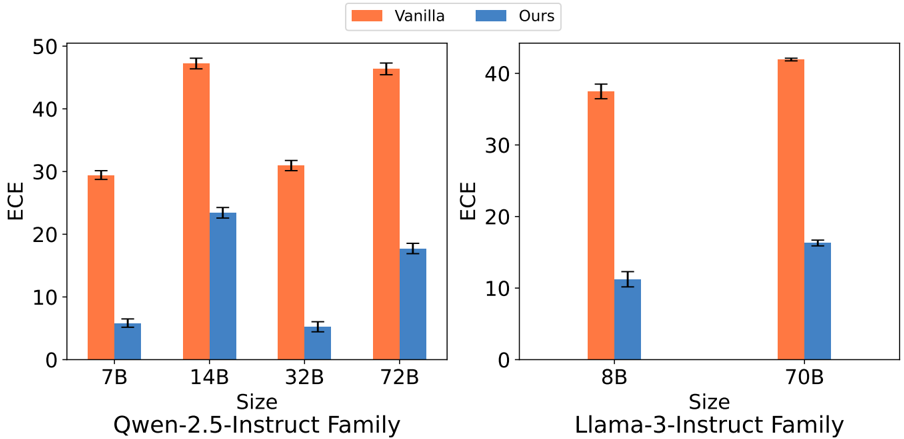
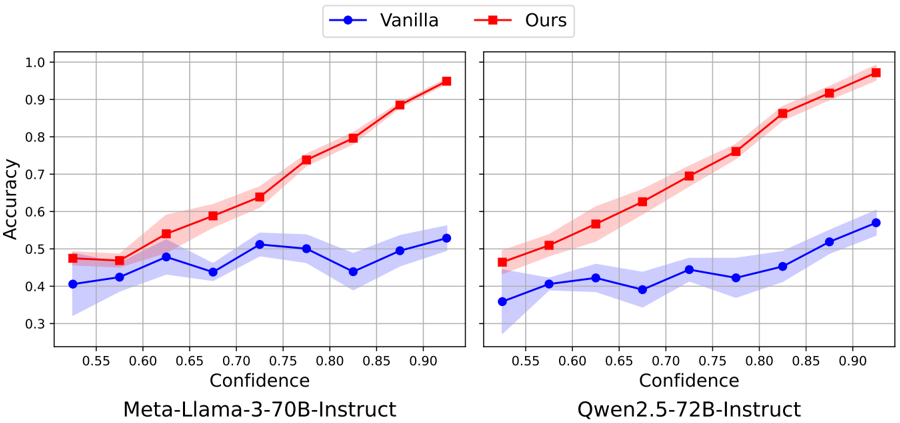
DACA extends beyond multiple-choice QA to open-ended tasks like TruthfulQA, where confidence is estimated via self-evaluation (P(True)). DACA significantly improves calibration, reducing ECE from 30.955% to 5.244% on Qwen2.5-32B-Instruct. It also enhances selective classification: by better aligning confidence with accuracy, DACA enables safer prediction filtering. As shown, accuracy on high-confidence predictions improves markedly under DACA, especially at higher thresholds, making it ideal for decision-critical applications where reliability trumps coverage.
@article{luo2024pretrained,
title={Your Pre-trained LLM is Secretly an Unsupervised Confidence Calibrator},
author={Luo, Beier and Wang, Shuoyuan and Li, Sharon and Wei, Hongxin},
journal={arXiv preprint arXiv:XXXX.XXXXX},
year={2024}
}